Monday, 17 June 2013

Follow Through Action


Appendages like loose material, a coat, scarf, a feather on a hat, a tail on an animal will 'follow through' with their movement in animation. If a character runs to a stop then his coat will follow through. As the coat settles, the most flimsy part will overlap the main body of the material.

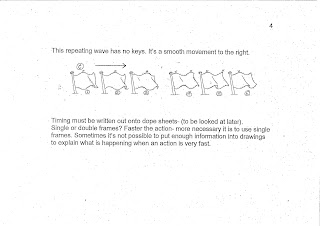
When this phenomenon is animated in a cycle, (the same drawings are reused), we can see eddies that follow a definite path before disappearing.

Task: Either import the images of the flag cycle and use them as a guide  to animate OR animate your own flag cycle. Do not add detail to the design, you will be marked on the movement/overlapping action.

Tip: Keep the flagpole constant by drawing it once on the level below the flag on the timeline and export everything

This six drawing cycle of a flag waving in the wind should be re-animated using Pencil software.
Be sure to incorporate the onion skin option.

Friday, 14 June 2013

Overlapping action


Follow Through and Overlapping Action are closely related techniques which, when applied to animation, can help to render movement more realistically, and help to give the impression that characters follow the laws of physics.
At the Disney Studio, Walt Disney was eager to push his animators to improve their work and develop their skills. He told them: "Things don't come to a stop all at once guys; first there's one part and then another"


The animators, keen to make their work feel more convincing, developed the concepts of "Follow Through" and "Overlapping Action", though the concepts were so closely related that they were not always easy to distinguish. Frank Thomas and Ollie Johnston identified five areas of motion where these principles would apply:
 1. A character might have a coat or long ears, and these parts would keep moving once the figure had stopped moving. The ears, or coat, would "follow through" even after the main action had stopped.

 2. Bodies in motion do not move all at once, rather different parts of a body may move at different speeds. Therefore, as one part of the body stops, another part (such as an arm), might overlap or follow through the main action, slowly settling to a stop.

 3. Loose flesh, such as a dog's floppy jowls, might move at a slower speed than the more solid parts of the character. These parts might drag behind the main action.

 4. The completion of an action - how the action "follows through" - is often more important than the action itself.

 5. The "moving hold". A character might come to a complete halt, but the fleshy parts might follow through the main action in order to convey weight and believability


DON'T forget the up and down movement of the bird.
Wings up - bird down.
Wings down - bird up.


Tuesday, 11 June 2013

Animation Unit - Timing and spacing and arcs


Over the course of this unit we will look at the principles of animation.


Timing and Spacing
The most important principles in animation are timing and spacing. Timing is about the key moments in a scene. If you are animating a bouncing ball, the timing to think about is when the ball hits the ground. The spacing to think about is how many drawings to do and how far away from each other they are.


Arcs
All actions, with few exceptions (such as the animation of a mechanical device), follow an arc or slightly circular path. This is especially true of the human figure and the action of animals. Arcs give animation a more natural action and better flow. Think of natural movements in the terms of a pendulum swinging. All arm movement, head turns and even eye movements are executed on an arcs.
We can decide on and map out these arcs before we start animating, bearing in mind that a bouncing ball loses momentum each time it bounces.  

Slow in / Slow out
As action starts, we have more drawings near the starting pose, one or two in the middle, and more drawings near the next pose. Fewer drawings make the action faster and more drawings make the action slower. Slow-ins and slow-outs soften the action, making it more life-like. For a gag action, we may omit some slow-out or slow-ins for shock appeal or the surprise element. This will give more snap to the scene.


Bouncing Ball Exercise
 Your first animation exercise will be to create a bouncing ball using Pencil Software. Once this is complete you should export your work as a Quicktime movie and save it. You will be compiling a showreel of the tasks from this unit which you can eventually post online. Today we will look at the Pencil interface and learn about... The timeline, Key frames, frames per second.

Wednesday, 5 June 2013

Body Language in Presentations

Body language is an important aspect of any performance. An actor's body language plays a crucial part in telling the audience about the character they are playing. What is body language? Body language is the way in which our bodies communicate our own or a character's attitudes. An audience or viewer can watch it to pick up on someone's age, emotions, status, or health. For example, a student being told off by a teacher in a tv drama can easily tell the audience that she's not feeling sorry for what she's done by: curling her lip showing a bored look in her eyes having her head slightly lowered putting a hand on her hip having her hip stuck out, with her weight on one leg.


Different types of body language Body language is the most important aspect of face-to-face communication. Anything you say can be enhanced or undermined by how you sit or stand or how you move your eyes. If you look bored then the audience will be. The purpose of any face-to-face communication is to engage the people you are talking to. They will then listen to what you have to say. If your body language is right, they will already be persuaded that you are worth listening to. There are three main types of body language: eye contact body position gesture and movement

Wednesday, 15 May 2013

Games Design Document (GDD)


Year 9 Games design document  Task 16.5.13

The Game Design Document (GDD) it the blueprint from which a computer or video game is to be built.  As such, every single detail necessary to build the game must be addressed in the document (or support documents). 
If it’s not in the document, then it probably won’t be in the game.

The purpose of a game design document is to unambiguously describe the game's selling points, target audience, gameplay, art, level design, story, characters, UI (user interaction), assets, etc.
In short, every game part requiring development should be included by the developer in enough detail for the developers to put it into place.
The majority of video games should require an inclusion or variation of the following sections:

   Story
   Characters
   Level/environment design
   Gameplay
   Art
   Sound and Music, User Interface, Game Controls

You are going to compile a GDD for an imaginary game of your own.
On the shared area is a GDD for a game called
‘Flint O’Connor and the Jewel of Halin’.
This describes the outline for one level of the game.

Overview:
This is like a quick description of the world the game is set in, the genre.
How the main character got here. What are the obstacles that will impede him are.

Gameplay:
How does the character defeat his enemies, reach specific points on the level? Does your game involve close quarter fights in order to reach goals? Solving puzzles? Does the player collect power-ups which help him to reach his objective? Can the character collect weapons? How do they work?
(See blog on Super Mario)


Characters:

Hero
Who is the main character? What makes him interesting?

Enemies

Easy enemies. They are different insects in our example game.
Medium enemies. They are wild cats in our example game.
Hard enemies. Something bigger, faster, stronger, hardest to defeat.

Flowchart:
Describes the geography of the game and whom the main character will encounter. Illustrate this using rectangles. (See the example GDD).

Map Overview:
The geography and crucial architecture of the game seen from above. (Plan view).


The document you need to create should be similar to this in layout although with less detail.
You should describe the following:

Overview
Text only

Gameplay
Text only

Characters
Text
Design
Skills and Procedures
Text

Flowchart
Text
Diagram
Map Overview

Design


Tuesday, 14 May 2013

Games Genre


Video game genres are used to categorise video games depending on their type of interaction rather than visual or narrative (story) differences. 

A video game genre depends on it's gameplay challenges. 
They can be listed by their setting or game-world content, not like other works of fiction such as films or books.
For example, an action game is still an action game, regardless of whether it takes place in a fantasy world or outer space. 
However, each video game genre still has certain elements that are there all the time. Most video games feature obstacles to overcome, so video game genres can be defined where obstacles are completed in similar ways.

Computer game design is always changing and developing. You can therefore expect the list given here to soon become out of date. 
As with nearly all varieties of genre, to a certain extent, a games genre will be open to personal interpretation. 
In film and TV, the audience looks for the iconography to decide what genre the text falls into. With gaming, defining the genre can be a little more complicated.

Moreover, it is important to be able to "think of each individual game as belonging to several genres at once."Genres and categories of games can help the organisations that are in place to protect certain groups (like under 18's) to develop classification.

Following is a listing of commonly used video game genres with brief descriptions and examples of each. This list is by no means complete there are even more genres and sub genres.

Contents:


1 Action1.1 Ball and paddleThe predecessor of all console game genres, a ball-and-paddle game was the first game implemented on a homeconsole (Pong). Later renditions have included Breakout, which was a driving influence behind the Apple II computer. 


1.2 Beat 'em up and hack and slash1.3 Fighting gameEmphasize one-on-one combat between two characters, one of which may be computercontrolled. This genre first appeared in 1976 with the release of Sega's Heavyweight Boxing and later became aphenomenon, particularly in the arcades, with the release of Street Fighter II


1.4 Maze game1.5 Pinball game1.6 Platform game1.7 Shooter1.7.1 First-person shootercommonly known as FPSs, emphasize shooting and combat from the perspective of the character controlled by the player. This perspective is meant to give the player the feeling of "being there", and allows the player to focus on aiming. Most FPSs are very fast-paced and require quick reflexes on high difficulty levels.Doom was the first major breakthrough in graphics; it used a number of clever techniques to make the game run fast enough to play on consumer-grade machines. Since the release of Doom, most FPS games now have a multi player feature to allow competition between multiple players. 


Games such as Team FortressHaloKillzone,Metroid PrimeUnreal TournamentQuakeHalf-LifeCall of DutyTimeSplitters and Battlefield are in the everexpanding first-person shooter genre.1.7.2 MMO FPS(Massively multiplayer online first person shooter)combines first-person shooter gameplay with a virtual world in which a large number of players can interact overthe Internet. hundreds of players can battle each other on the same server in an MMOFPS. An example of a MMOFPS is PlanetSide 2.


1.7.3 Light gun shooter1.7.4 Shoot 'em up (SHMUP)1.7.5 Tactical shooter1.7.6 Rail shooter1.7.7 Third-person shooter

2 Action-adventurecombine elements of their two component genres, typically featuring long-term obstacles that must be overcomeusing a tool or item as leverage (which is collected earlier), as well as many smaller obstacles almost constantlyin the way, action-adventure games are often confusingly called "adventure games" by gamers.2.1 Stealth gameare a somewhat recent sub-genre, sometimes referred to as "sneakers" or "creepers" to contrast with the action oriented "shooter" sub-genre.2.2 Survival horrorGames focus on fear and attempt to scare the player via traditional horror fiction elements such as atmospherics, death, the undead, blood and gore.3 Adventurewere some of the earliest games created, beginning with the text adventure Colossal Cave Adventure in the 1970s. That game was originally titled simply "Adventure," and is the namesake of the genre. Over time,graphics have been introduced to the genre and the interface has evolved. The genre peaked in popularity with the 1993 release of Myst, the best-selling PC game of all time up to that point. The simple point and click interface, detailed worlds and casual pace made it accessible, and its sense of artistic surrealism caused news outlets such as Wired MagazineThe New York Times and the San Francisco Chronicle to declare that thegaming industry had matured.


3.1 Real-time 3D adventures3.2 Text adventures3.3 Graphic adventures3.4 Visual novels4 Role-playingdraw their gameplay from traditional role-playing games like Dungeons & Dragons. Most cast the player in the role of one or more "adventurers" who specialize in specific skill sets (such as melee combat or casting magic spells) while progressing through a predetermined storyline. Many involve maneuvering these character(s) through an overworld, usually populated with monsters, that allows access to more important game locations, such as towns, dungeons, and castles.


4.1 Western RPGs and Japanese RPGs (JRPGs)4.2 Use of fantasy in RPGs4.3 Sandbox RPGs4.4 Action RPGs4.5 MMORPGs4.6 Rogue RPGs4.7 Tactical RPGs5 Simulationvideo games is a diverse super-category of games, generally designed to closely simulate aspects of a real or fictional reality.


5.1 Construction and management simulation5.2 Life simulationThis includes popular examples of virtual pets such as Tamagotchi, the Petz series, and Nintendogs.5.3 Vehicle simulationgames are a genre of video games which attempt to provide the player with a realistic interpretation of operatingvarious kinds of vehicles.

Flightgear:

6 StrategyVideo games focus on gameplay requiring careful and skillful thinking and planning in order to achieve victory. Inmost strategy video games "the player is given a godlike view of the game world, indirectly controlling the unitsunder his command.6.1 4X game6.2 Artillery game

Scorched 3d is an artillery game:


6.3 Real-time strategy (RTS)6.4 Real-time tactics6.5 Tower defense6.6 Turn-based strategy6.7 Turn-based tactics6.8 Wargame

7 Other notable genres7.1 Arcade game7.2 Music game7.3 Party game7.4 Programming game7.5 Puzzle game7.6 Sports game7.7 Trivia game7.8 Board game / Card game

8 Video game genres by purpose8.1 Adult video game8.2 Advergame8.3 Art game8.4 Casual game8.5 Christian game8.6 Educational game8.7 Electronic sports8.8 Exergame8.9 Serious game